The Science Behind Truvtus,
part 2: Beyond Personality Tests
Most organizations trying to fix friction, disengagement, or culture clash turn to personality tests. They administer DISC, Myers-Briggs (MBTI), or Enneagram assessments, hoping a four-letter acronym or color quadrant will explain why high-performing teams suddenly stall.
Yet months later, the friction persists. Why?
Because personality is how someone behaves; values are why they care.
If you only measure communication style, you miss the invisible operating system driving every decision, conflict, and departure in your organization. Truvtus is built on a very different foundation: the empirical science of human motivational values.
The Blind Spot of Personality Testing
Personality tests measure behavioural traits and temperamental preferences. They tell you whether an employee is introverted, detail-oriented, expressive, or task-focused.
That is useful for day-to-day conversation, but it fails under pressure:
- Two people can both be extraverted and results-oriented (identical personality profiles), yet one is motivated by Power & Status while the other is driven by Universalism & Societal Impact. Under financial strain, they will tear each other apart over strategy.
- An employee might be quiet and agreeable on a personality quiz, but if their core operating value is Self-Direction, micro-management will drive them out the door within months.
Personality describes style. Values define stakes. When organizational culture breaks down, it is almost never a failure of personality—it is a collision of fundamental values.
Feel like you missed the beginning? Explore the science behind Truvtus, Part 1: The Hidden Mismatch.
The Schwartz Theory: A Cross-Cultural Foundation
Truvtus relies on the Theory of Basic Human Values, developed by psychologist Dr. Shalom H. Schwartz. Validated across more than 80 countries and hundreds of thousands of participants over three decades, it is one of the most rigorously tested frameworks in cross-cultural psychology.
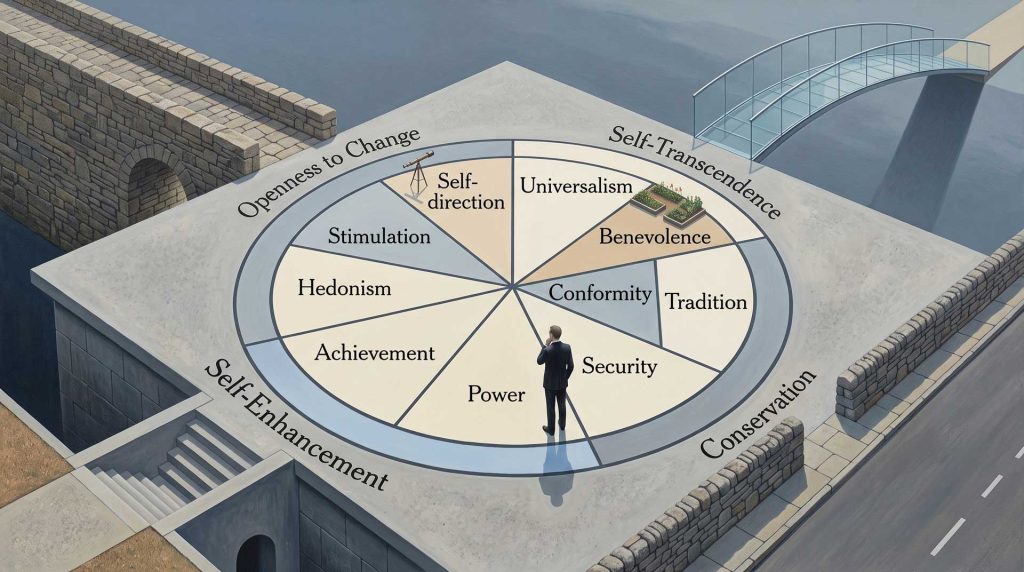
Schwartz identified ten universal values present in every culture. More importantly, he mapped their systemic architecture—how they naturally support or contradict one another along two primary axes of human tension:
1. Openness to Change vs. Conservation:
- Openness to Change (Self-Direction, Stimulation): Drives agility, autonomy, innovation, and independent thought.
- Conservation (Security, Conformity, Tradition): Drives stability, compliance, risk mitigation, and proven operational playbooks.
- In Business: This is the classic friction between your R&D team demanding rapid iteration and your compliance/operations team requiring strict protocol.
2. Self-Transcendence vs. Self-Enhancement:
- Self-Transcendence (Benevolence, Universalism): Prioritizes collective well-being, trust, team cohesion, and customer care.
- Self-Enhancement (Achievement, Power): Prioritizes competence, competitive advantage, market dominance, and personal success.
- In Business: This defines whether your organization is built on internal competition and individual KPIs, or collaborative mission and stakeholder stewardship.
The Ten Operational Drivers
Rather than subjective labels, the Schwartz model identifies ten discrete motivational drivers:
- Self-Direction: Independence in thought and action; freedom to innovate.
- Stimulation: Excitement, novelty, and bold challenges.
- Hedonism: Enjoyment, flow, and positive experience at work.
- Achievement: Competence and personal success measured against standards.
- Power: Authority, control, resource ownership, and market prestige.
- Security: Safety, financial predictability, and organizational stability.
- Conformity: Adherence to rules, self-restraint, and meeting commitments.
- Tradition: Respect for institutional knowledge, legacy, and shared rituals.
- Benevolence: Protecting and elevating the immediate team; mutual support.
- Universalism: Fairness, ethical responsibility, and long-term societal impact.
No value is inherently “good” or “bad.” A high-growth startup requires high Self-Direction; an aviation maintenance unit requires uncompromising Conformity and Security. Dysfunctions happen when leadership demands one set of behaviours while rewarding another—or blindsides employees by ignoring what truly drives them.
For the Anxious Leader: Why This Is Not “Another Box”
Leaders are rightfully wary of assessments that reduce complex professionals to a four-letter acronym, a colour quadrant, or 16 rigid MBTI stereotypes. Real people do not fit into prefabricated bins.
Truvtus rejects the “boxing” trap on three fundamental counts:
- Values Only Exist in Hierarchy: An isolated value tells you nothing – as all values are good by definition. What drives real behaviour is the relative trade-off between values under pressure. A leader high in Achievement acts completely differently when their second priority is Benevolence versus when it is Power.
- A Unique Motivational Fingerprint: We measure 9 distinct dimensions across 100 continuous levels. Mathematically, that creates one quintillion () of potential configurations. No two employees or teams share the exact same profile; with Truvtus, you are mapping an individual operating blueprint, not forcing them into a pigeonhole.
- Anonymous Diagnostics, Not Moral Judgments: We do not evaluate “character” or score one profile over another. Individual responses remain private; data is aggregated into maps so leadership can spot friction and alignment without putting anyone under a microscope.
When you align your organization at the value layer, you don’t have to manage every behavioural symptom. The culture takes care of itself.
Ready to see where your team aligns?
Explore the 3 Dimensions of Alignment →
or revisit Part 1: The Hidden Mismatch →
Key Sources & Further Reading
– for leaders and researchers who want to examine the primary literature:
-
- “Theory of basic human values” in Wikipedia
A great starting point for a general overview.
- “Theory of basic human values” in Wikipedia
-
- An Overview of the Schwartz Theory of Basic Values
Schwartz, S. H. (2012). Online Readings in Psychology and Culture, 2(1). A comprehensive summary from the author himself.
- An Overview of the Schwartz Theory of Basic Values
-
- Universals in the Content and Structure of Values
Schwartz, S. H. (1992). Advances in Experimental Social Psychology, 25. The seminal paper that established the theory.
- Universals in the Content and Structure of Values
-
- Value Priorities and Behavior: Applying a Theory of Integrated Value Systems
Schwartz, S. H. (1996). A paper exploring how values influence real-world behavior.
- Value Priorities and Behavior: Applying a Theory of Integrated Value Systems